
Toyota Highlander Service Manual: Replacement
1. DISCHARGE REFRIGERANT FROM REFRIGERATION SYSTEM
(a) Turn the A/C switch on.
(b) Operate the cooler compressor at an engine rpm of approximately 1,000 for 5 to 6 minutes to circulate the refrigerant and collect compressor oil remaining in each component into the cooler compressor as much as possible.
(c) Stop the engine.
(d) Using SST, let the refrigerant gas out.
SST 07110-58060 (07117-58080, 07117-58090, 07117-78050, 07117-88060, 07117-88070, 07117-88080)
2. CHARGE REFRIGERANT
(a) Using a vacuum pump, perform vacuum purging.
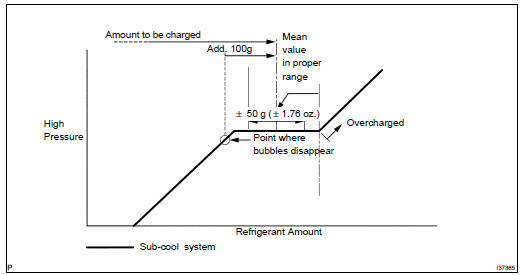
(b) Using SST charge refrigerant, HFC-134a (R134a).
Standard: 650 50 g (22.93 1.76 oz.) SST 07110-58060 (07117-58060, 07117-58070, 07117-58080, 07117-58090, 07117-78050, 07117-88060, 07117-88070, 07117-88080)
NOTICE: Do not start the engine before charging with refrigerant as the cooler compressor doesn't work properly without any refrigerant, which causes the compressor to overheat.
3. WARM UP ENGINE
NOTICE: Warm up the engine at less than 2000 rpm for 2 minutes or more after charging with refrigerant.
4. INSPECT LEAKAGE OF REFRIGERANT
(a) Perform in these conditions:
- Stop the engine.
- Secure good ventilation (the gas leak detector may not react to volatile gases which are not refrigerant, such as evaporated gasoline and exhaust gas).
- Repeat the test 2 or 3 times.
- Make sure that there is some refrigerant remaining
in the refrigeration system.
When compressor is off: approx. 392 to 588 kPa (4 to 6 kgf/cm2, 57 to 85 psi)
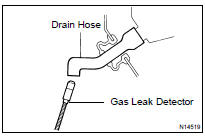
(b) Bring the gas leak detector close to the drain hose before performing the test.
HINT:
- After the blower motor has stopped, leave the cooling unit for more than 15 minutes.
- Expose the gas leak detector sensor under the drain hose.
- When bringing the gas leak detector close to the drain hose, make sure that the gas leak detector does not react to the volatile gases.
If such reaction is unavoidable, the vehicle must be lifted up.
(c) If a gas leak is not detected on the drain hose, remove the blower motor control (blower resistor) from the cooling unit. Insert the gas leak detector sensor into the unit and perform the test.
(d) Disconnect the connector and leave the pressure switch for approximately 20 minutes. Bring the gas leak detector close to the pressure switch and perform the test.
(e) Bring the gas leak detector close to the refrigerant lines and perform the test.
 On-vehicle inspection
1. INSPECT REFRIGERANT VOLUME
(a) Check the sight glass on the cooler refrigerant liquid pipe
A.
Test conditions:
Engine is running at 1,500 rpm
Blower speed control switch is at "HI" ...
 Heater & air conditioner
COMPONENTS
...
More about Toyota Highlander:
