
Toyota Highlander Service Manual: On-vehicle inspection
1. INSPECT REFRIGERANT VOLUME
(a) Check the sight glass on the cooler refrigerant liquid pipe A.
Test conditions:
- Engine is running at 1,500 rpm
- Blower speed control switch is at "HI"
- A/C switch is ON
- Temperature control dial is at "MAX. COOL"
- Doors are fully open
|
Item |
Symptom |
Amount of refrigerant |
Corrective Actions |
|
1 |
Bubbles exist | Insufficient* | (1) Check for gas leakage and repair if necessary (2) Add refrigerant until bubbles disappear |
| 2 | No bubbles exist | Empty, insufficient or excessive | Refer to 3 and 4 |
| 3 | No temperature difference between compressor inlet and outlet | Empty or nearly empty | (1) Check for gas leakage with gas leak detector and repair if necessary (2) Add refrigerant until bubbles disappear |
| 4 | Considerable temperature difference between compressor inlet and outlet | Proper or excessive | Refer to 5 and 6 |
| 5 | Immediately after air conditioning is turned off, refrigerant clears | Excessive | (1) Discharge refrigerant (2) Remove air and supply proper amount of purified refrigerant |
| 6 | Immediately after air conditioning is turned off, refrigerant foams and then becomes clear | Proper |
- |
*: Bubbles in the sight glass with ambient temperatures higher than usual can be considered normal if cooling is sufficient.
2. INSPECT REFRIGERANT PRESSURE WITH MANIFOLD GAUGE SET
(a) This is a method in which the trouble is located by using a manifold gauge set. Read the manifold gauge pressure when these conditions are established.
Test conditions:
- Temperature at the air inlet with the switch set at RECIRC is 30 to 35C (86 to 95F)
- Engine is running at 1,500 rpm
- Blower speed control switch is at "HI"
- Temperature control dial is at "COOL"
- A/C switch is ON
- Doors are fully open
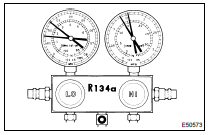
- Normally functioning refrigeration system
Gauge reading: Low pressure side: 0.15 to 0.25 MPa (1.5 to 2.5 kgf/cm2) High pressure side: 1.37 to 1.57 MPa (14 to 16 kgf/cm2)
- Moisture is present in refrigeration system
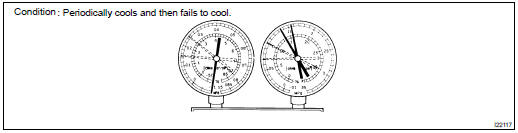
|
Symptom |
Probable cause |
Diagnosis |
Corrective Actions |
| During operation, pressure on low pressure side cycles between normal and vacuum | Moisture in refrigeration system
freezes at expansion valve orifice,
causing a temporary stop of cycle. However, when it melts, normal state is restored. |
|
|
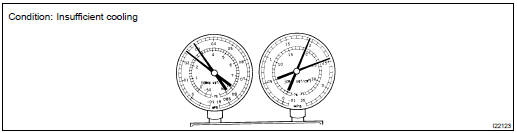
- Insufficient cooling
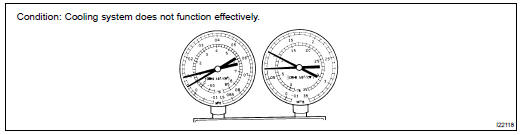
|
Symptom |
Probable cause |
Diagnosis |
Corrective Actions |
|
Gas leakage in refrigeration system |
|
|
- Poor circulation of refrigerant
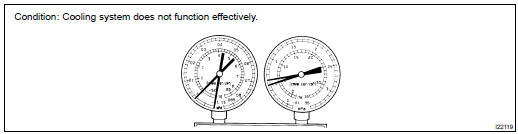
|
Symptom |
Probable cause |
Diagnosis |
Corrective Action |
|
Refrigerant flow is obstructed by dirt in the receiver | Receiver is clogged | Replace condenser |
- Refrigerant does not circulate
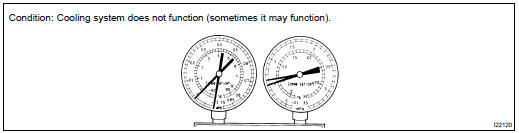
|
Symptom |
Probable cause |
Diagnosis |
Corrective Actions |
|
|
Refrigerant does not circulate |
|
- Refrigerant is overcharged or cooling effectiveness of condenser is insufficient
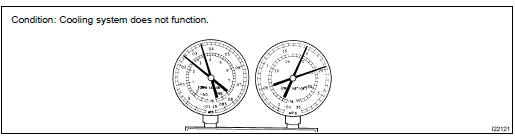
|
Symptom |
Probable cause |
Diagnosis |
Corrective Actions |
|
|
|
|
- Air present in refrigeration system
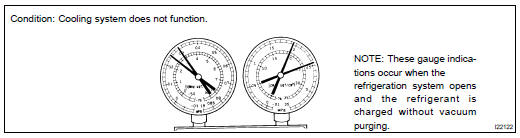
|
Symptom |
Probable cause |
Diagnosis |
Corrective Actions |
|
Air in system |
|
|
- Expansion valve malfunction
|
Symptom |
Probable cause |
Diagnosis |
Corrective Actions |
|
Trouble in expansion valve |
|
Check expansion valve |
- Defective compressor
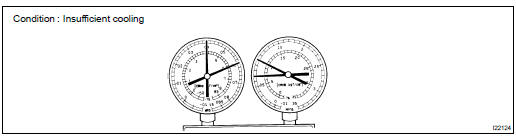
|
Symptom |
Probable cause |
Diagnosis |
Corrective Actions |
|
Internal leak in compressor |
|
Repair or replace compressor |
Gauge readings (Reference)
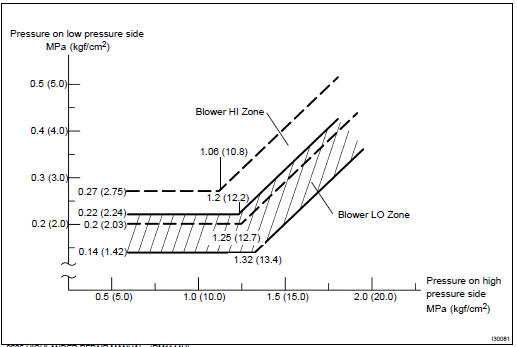
 Refrigerant
...
 Replacement
1. DISCHARGE REFRIGERANT FROM REFRIGERATION SYSTEM
(a) Turn the A/C switch on.
(b) Operate the cooler compressor at an engine rpm of approximately 1,000 for 5
to 6 minutes to circulate
the refrig ...
More about Toyota Highlander:
Rear wheel alignment
ADJUSTMENT
1. INSPECT TIRE (SEE PAGE 28-1 )
2. MEASURE VEHICLE HEIGHT (SEE PAGE 26-7 )
NOTICE:
Before inspecting wheel alignment, adjust the vehicle height to the specified
value.
3. INSPECT TOE-IN
HINT:
Measure "C - D" only when "A + B" cannot be measured.
If the toe-in is not wit ...
